Chronograph, the Ultimate Sports Function
The desire to measure and segment time predates watchmaking itself. Yet the invention of the chronograph, as we know it today, is the result of centuries of ingenuity and mechanical evolution. The mechanical chronograph emerged from the scientific and industrial revolutions of the 19th century, reflecting modern society’s growing reliance on precise time measurement.
The ability to accurately display elapsed time introduced the idea of performance, making the chronograph an essential complication across various domains, from scientific and military to cultural settings, including sports such as horse racing. The first modern chronograph (1862) featured three functions: start, stop, and zero resetting. In 1875, the two founders of Audemars Piguet immediately adopted this new feature for their pocket watches, which paved the way for the brand’s rich legacy of innovative chronograph wristwatches.
CHRONOGRAPH Watches
A chronograph is a complication that measures and allows the reading of time continuously or by interval, without affecting the precision of the watch. Once activated, the push-pieces allow the chronograph hand to be started, stopped and restarted at will, then reset to zero. A chronograph is technically complex to realize because the synchronization of several components must be fast, precise and fluid.
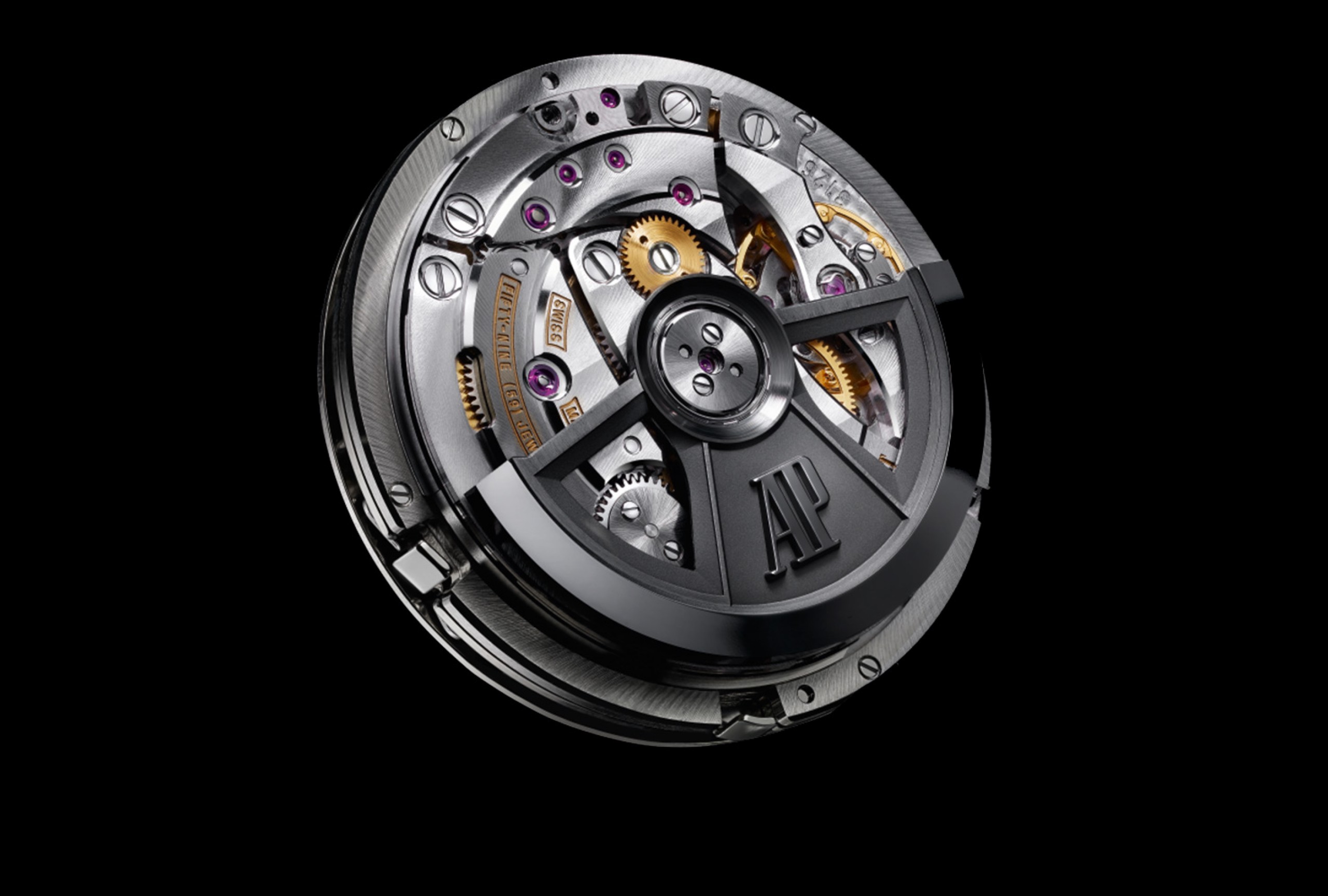
THE COMPLICATION OF PRECISION AND PERFORMANCE
Audemars Piguet introduced its first chronograph wristwatches in the 1930s. Produced in extremely limited numbers – with just 307 pieces before 1980 – these timepieces are among the rarest in the world. At the time, each watch crafted by the Manufacture was a unique creation, with the concept of standardised models only introduced in the 1950s.

1933
For the first time at Audemars Piguet, the pushpiece located at 2 o’clock, controlling the start, stop, and zeroresetting functions, is separated from the crown, marking the first stage in the shift towards the modern chronograph wristwatch. AP Heritage Inv. 215

1943
Highly contemporary for its time, premodel 1533 is distinguished by the additional pushpiece and the hour counter on the dial, both of which reflect the second major step in the evolution of the chronograph complication. With Calibre 13VZAH, the column wheel controls two functions, allowing to successively stop and start the chronograph. Given that zeroresetting was activated by a separate pushpiece, this system enabled an additional «restart» function. AP Heritage Inv. 1660

1955
Distributed between 1955 and 1961, Model 5521 reflects the brand’s dedication to design innovation at a time when the chronograph’s evolution was on hold. This reference is distinguished by its 18carat yellow gold case with a large bezel and extended curved lugs. AP Heritage Inv. 1749

1980
After disappearing from Audemars Piguet’s offering between the 1960s and the 1980s, the chronograph is revived at Audemars Piguet in two acts. The first begins when watchmakers combine the classic sports function with the meticulous art of openworking, like on this handdecorated wristwatch providing enhanced views of the mechanism, engravings and finishing. Ref. 5556BA

1930
Produced in only three examples, this chronograph wristwatch is among Audemars Piguet’s earliest creations in this category. It uses a single pushpiece integrated into the crown to control the start, stop, and reset functions. Powered by Calibre 11GCCV, this platinum timepiece features a doublecounter dial with chronograph minutes at 3 o’clock and small seconds at 9 o’clock. AP Heritage Inv. 2383

1986
Six years later, the functionality of the chronograph meets the ease of the selfwinding feature for the second act of this complication’s renewal. Calibre 2126/2840, the first selfwinding chronograph movement at Audemars Piguet, first equips a small collection of round watches occasionally referred to as the Huitième. Ref. 25644TR

1993
To power the first Royal Oak Offshore, the Manufacture relies on tried and tested Calibre 2126/2840, defining the “Beast” as Audemars Piguet’s ultimate sportive reference. This selfwinding movement measuring 6.15 mm is composed of two parts made in collaboration with manufacturers from Le Brassus: the base, by LeCoultre & Cie, and the underdial chronograph, by Dubois Dépraz. Ref. 25721

1997
The first Royal Oak Chronograph, introduced in 1997, combined the avantgarde design of the Royal Oak with the sophistication of the Manufacture’s newly developed selfwinding chronograph movement, Calibre 2385. Measuring only 5.5 mm thick, this feat of microengineering was the result of a collaboration between Audemars Piguet and movement blank manufacturer Frédéric Piguet. Ref. 25860ST

2005
Calibre 2326/2847 introduces the flyback chronograph with a countdown device specifically designed for regatta starts. This function allows to stop, reset and instantly restarts the chronograph, while the dedicated aperture at 12 o’clock changes from black to red during the last minute before the start of the race. Ref. 26040ST

2015
Designed to time and compare multiple consecutive laps, Calibre 2923 combines a single chronograph driving two central hands with the flyback function, making it capable of recording times down to oneeighth of a second. Presented in the Royal Oak Concept Laptimer, this groundbreaking chronograph was created for Michael Schumacher. Ref. 26221FT

2019
Calibre 4401, the brand’s latest integrated chronograph movement, is launched within the newly unveiled Code 11.59 by Audemars Piguet collection. This inhouse movement features the flyback function, a patented process allowing the column wheel to work with the vertical clutch system for enhanced isochronism and reduced startup jumps. Ref. 26393BC

2023
The hightech Calibre 4407 combines a flyback chronograph, splitseconds, GMT function and large date. The splitseconds complication, which enables to measure intermediate time intervals, is integrated within the thickness of the rotor’s ball bearing, making this mechanism visible through the sapphire caseback a first as it is usually hidden from view in selfwinding watches. Ref. 26650TI
CALIBRE 8100, A NEW CHRONOGRAPH ENERGY
Entirely reimagined to meet our clients’ expectations, the RD#5 brings together all the hallmarks of a refined chronograph: a world-first in the touch-sensitive push-pieces, an instantaneous jump minute counter, remarkable thinness, and meticulously designed ergonomics and legibility.
Giulio Papi
Director of Watchmaking Design, Audemars Piguet

SPLIT-SECONDS Hands
Split-seconds chronographs are fitted with an additional second hand that can be stopped in its tracks in order to measure an intermediate, or to maintain a reference time. When activated at the start of a race, both hands begin together. The split-seconds hand can be stopped at any moment to measure a time, while the chronograph hand continues its course. At a simple press of a push-piece, the split-seconds hand jumps back in unison with the chronograph hand.
FLYBACK CHRONOGRAPH
The flyback function on a chronograph enables to reset and instantaneously restart the chronograph hands without having to stop the chronograph first.

A watch is born
Follow the making of our latest in-house chronograph with flyback function, Calibre 4401. All our movements are born from the expertise of our watchmakers, engineers and craftspeople working in perfect harmony with cutting-edge technologies.
The goal has remained the same since 1875: to take advantage of the best of both worlds to create innovative mechanisms finished with exquisite decorations and assembled by hand.


LAPTIMER CHRONOGRAPH
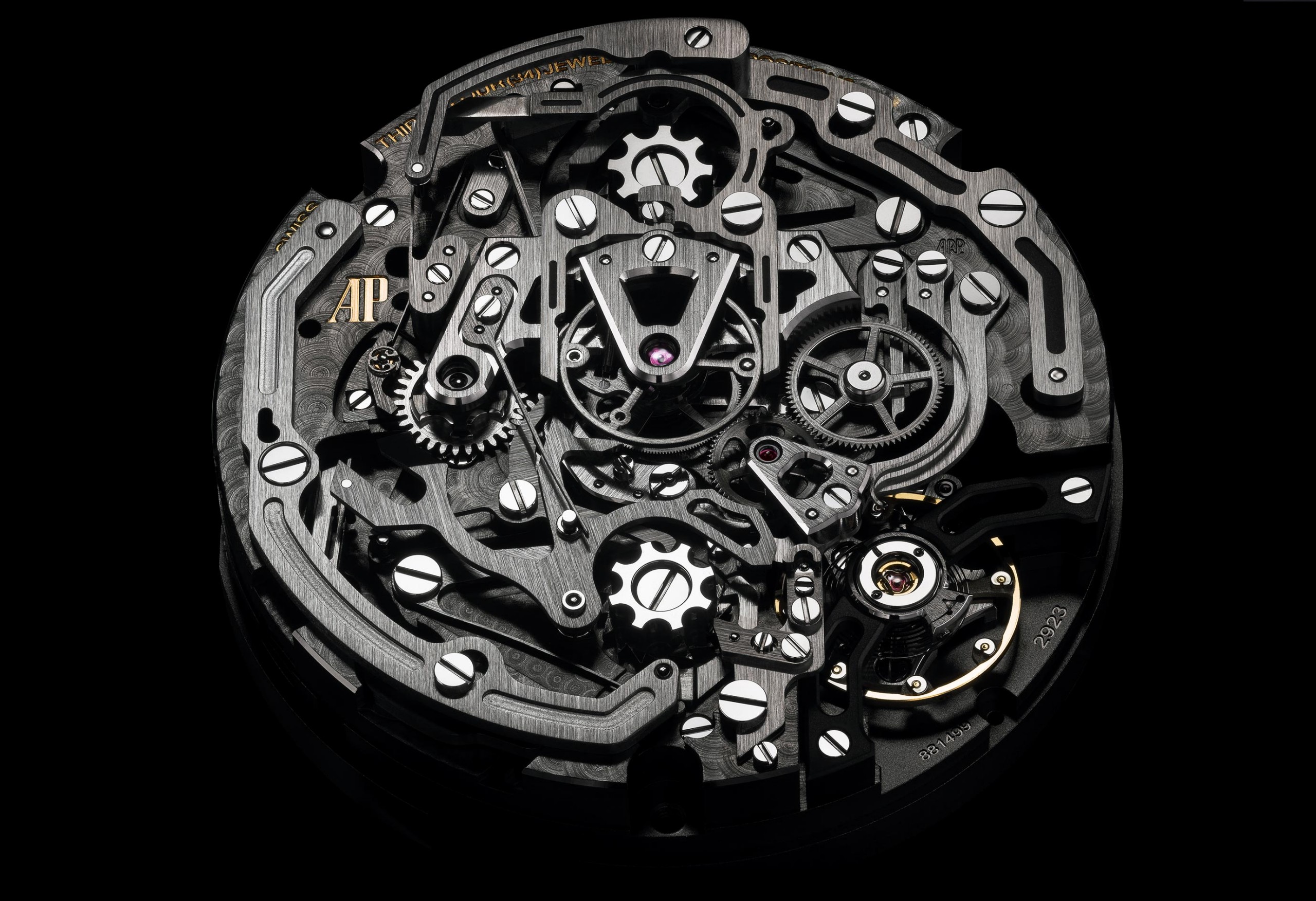
In 2010, Michael Schumacher challenged Audemars Piguet engineers to create a mechanical wristwatch that could measure multiple consecutive lap times on the racetrack, without having to restart the stopwatch at the end of each lap. This could only be done digitally before! Five years later, the Manufacture released the Laptimer, featuring a single chronograph with flyback function driving two central sweep-seconds hands that can be controlled independently via three push-pieces.
This patented mechanism features no fewer than three column wheels. One of the column wheels, located at six o'clock, controls the chronograph sequence; while the two other wheels, positioned at twelve o'clock, control the complex laptimer sequence.
Explore the timepieces
More about Complications

AP Talks about Complications with Austen Chu
In this third episode, we have the great joy to welcome Austen Chu, founder and CEO of Wristcheck and Horoloupe and Thomas Richard, Expert in Complications at AP, to deep dive into our most complicated watches.
Read more
AP Talks about Chiming
It takes ingenuity and precision to strike the perfect chord. Discover the secrets behind chiming complications with Lucas Raggi, Development Director, and Sébastian Vivas, Heritage and Museum Director.
Read more
AP Talks about the Code 11.59 by Audemars Piguet Universelle
The culmination of 7 years of research and development, drawing upon the human talents working in various disciplines, the Code 11.59 by Audemars Piguet Universelle pays tribute to the grand complication.
Read more
Revolutionary Ergonomics featuring Calibre 7138
Building on its heritage and past developments while looking to the future, Audemars Piguet has reimagined the perpetual calendar mechanism with ergonomics in mind.
Read more
Find a boutique
We invite you to visit our AP Houses and boutiques to explore a variety of Audemars Piguet timepieces and receive expert watch servicing from our skilled professionals, by appointment or walk-in.